April 2026 Newsletter: Who’s Winning, Who’s Falling Behind
SaaS defends its moats
Salesforce’s “Headless 360” turns its entire platform into infrastructure for AI agents, exposing data, workflows, and business logic through 60+ MCP tools — no browser required. External agents like Claude Code, Cursor, and Codex get live access to a customer’s full Salesforce org. Usage is capped and billed by workload. Source
ServiceNow CEO Bill McDermott argues replacing enterprise platforms with LLMs costs 10x more, factoring in GPUs, tokens, and labor. While cross-functional SaaS platforms remain resilient, he warns narrow departmental tools are highly vulnerable to disruption—especially since businesses “never will forgive software for making a mistake.” Source
Struggling to keep pace with change
GitHub expects engineering output to surge 14x by 2026, but revenue functions lag severely. BCG notes 70% of AI’s value lies in core areas like sales and R&D, yet only 5% extract value at scale. Similarly, McKinsey finds just 6% of European marketers claim high AI maturity. Source | Source | Source
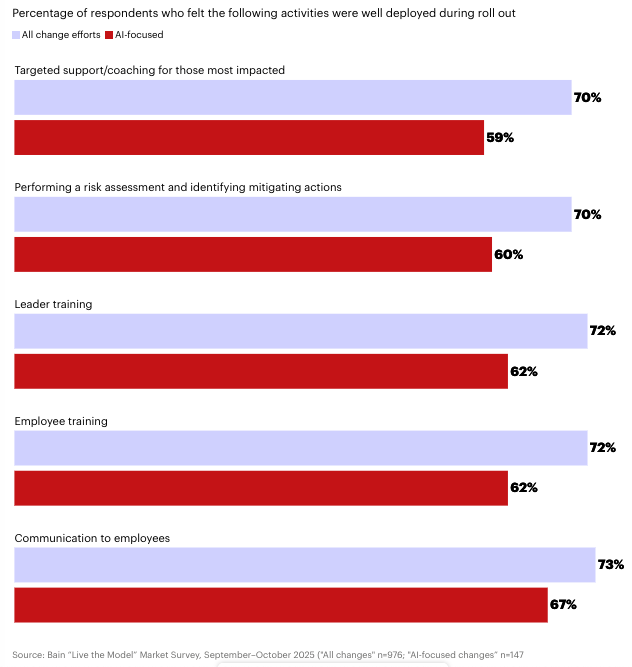
According to Bain, employees are less motivated to embrace AI-driven change (33%) versus other reorganizations (43%). Adoption lags not from a lack of awareness, but because AI transformations often omit essential change management tools like targeted coaching to help employees learn how to actually work differently. Source
Source: Bain
AI delivers in the lab

Source: Gemini
Novo Nordisk built AI agents using Celonis to monitor active clinical trials, flagging protocol gaps and delays before they compound — replacing hundreds of outside contractors in the process. Novo’s digital transformation officer estimates a single week shaved off time-to-market can be worth hundreds of millions in peak revenue for the Ozempic maker. Source
According to Reuters, AWS launched Amazon Bio Discovery, a no-code AI app using biological foundation models to accelerate drug development. Partnering with Memorial Sloan Kettering Cancer Center, the platform generated 300,000 novel antibodies, winnowing them to 100,000 candidates for lab testing by Twist Bioscience—compressing months into weeks. Source
Model providers — the bets being made
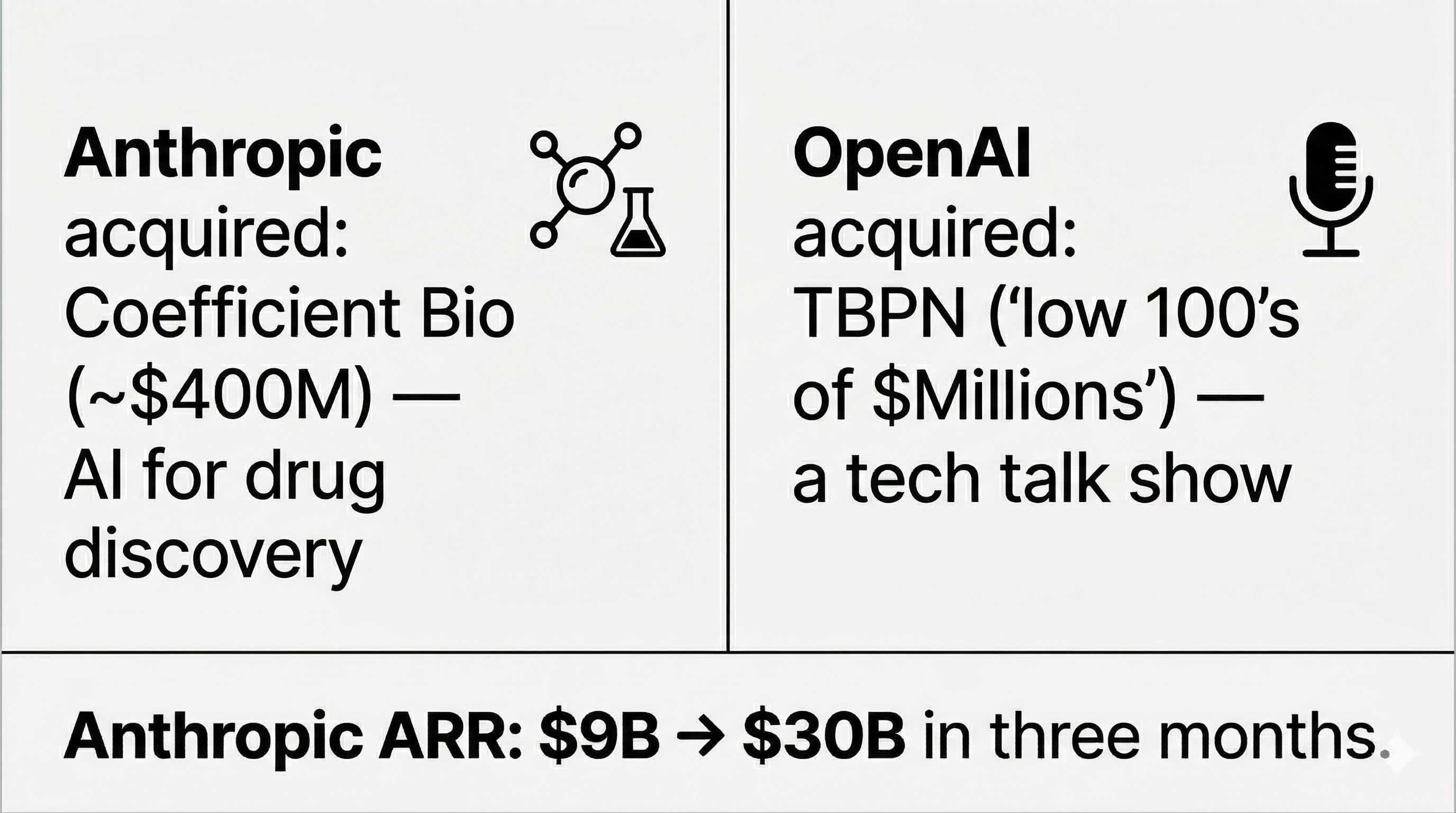
Anthropic ARR tripled in 3 months from $9B to $30B and secured a deal with Broadcom and Google for 3.5 gigawatts of capacity in 2027. They bought Coefficient Bio ($400m) while OpenAI bought TBPN (reportedly low-hundreds-of-millions), a tech podcast. Enterprises, strong users of Claude Code, are voting with their dollars. Source | Source | Source
Source: Anthropic / OpenAI
As model providers vie for user trust, AI shopping agents still face steep hurdles. According to Modern Retail, OpenAI’s recent pivot away from ChatGPT’s Instant Checkout underscores a clear consumer boundary — shoppers just aren’t ready to hand off the final transaction experience to an AI. Source
AI and security — who’s watching the watchers?
According to Axios, Anthropic and OpenAI are restricting their new cyber-permissive models, Mythos and GPT-5.4-Cyber, to vetted security organizations. Yet existing models already pose threats — Sequoia-backed startup Buzz built an AI agent that autonomously exploited 103 public vulnerabilities, most taking under an hour. Source | Source
Gartner predicts over 50% of enterprises will adopt AI security platforms by 2028. While giants like ServiceNow and startups like Wayfound enter the space, some remain skeptical. Unilever tapped six-year-old Holistic AI for independent governance, wary of using the same LLMs to both act and monitor. Source
How capable is AI, really?
According to the ARC Prize Foundation, the ARC-AGI-3 benchmark reveals a stark capability gap — humans can solve 100% of its environments, while frontier AI scores under 1%. By explicitly penalizing brute-force memorization, the turn-based exam tests true agentic efficiency—evaluating exploration, modeling, goal-setting, and planning under uncertainty. Source