AI Will Reshape More Jobs Than It Replaces
40-45% of US jobs will be reshaped by AI. Only 10-15% eliminated. CEOs who understand the difference will invest differently.
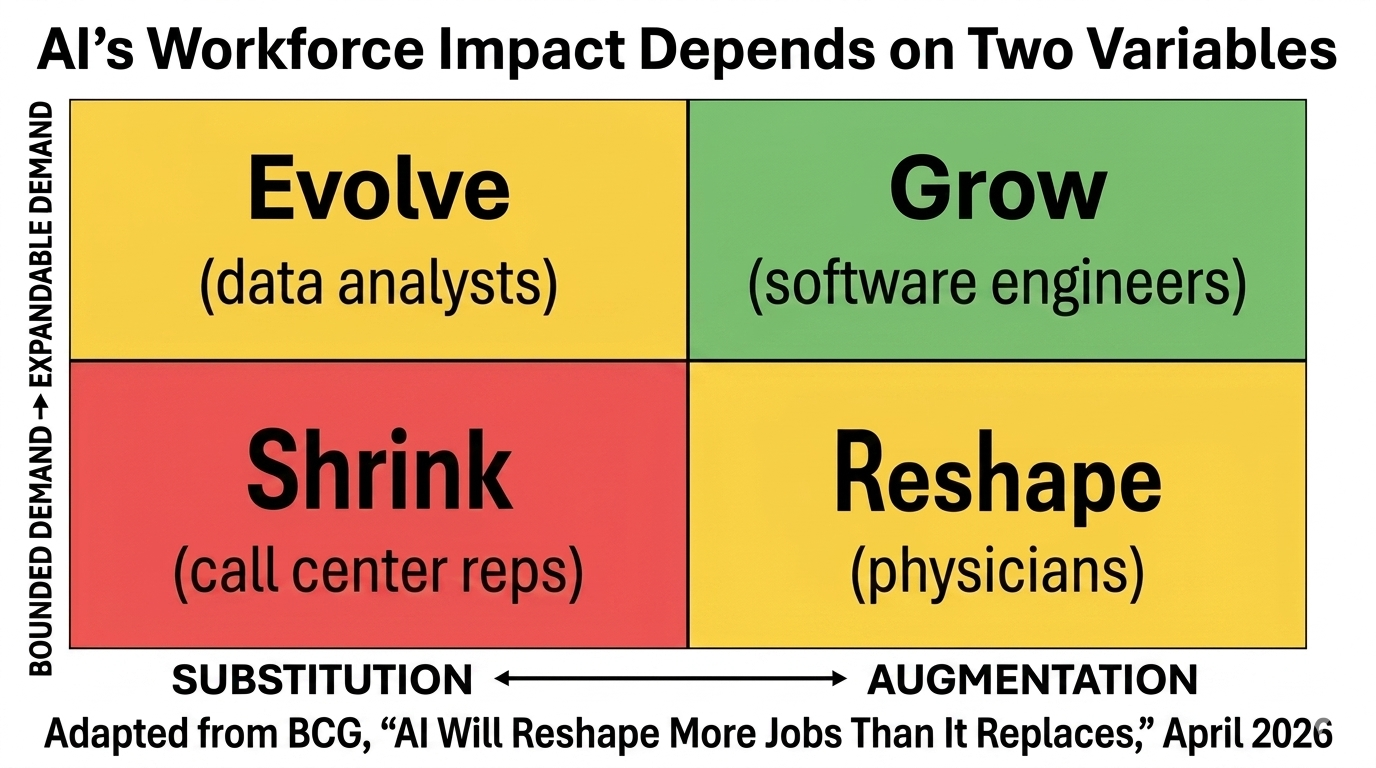
Source: BCG, April 2026
The difference comes down to two factors most executives are not explicitly considering.
In my consulting practice, I’m noticing that tasks and roles are being affected very differently by AI. Some are being replaced (order entry, contract validation). Some are expanding (IT provisioning for AI data structures). Some are new (domain-based coaches for agent implementation). Some are being enabled (audits that were too time-consuming are now reviewable and actionable).
BCG’s April 2026 analysis names the two variables. link
Factor 1: Substitution vs. Augmentation
AI substitutes for transactional, repeatable, rule-based work. It augments work that requires judgment, context, and open-ended problem solving.
Call center reps handle scripted troubleshooting within defined workflows—AI executes end-to-end, reducing headcount. Software engineers make architectural tradeoffs and translate business needs into solutions—AI accelerates coding but can’t own the outcome, so engineers shift to higher-level design work.
Factor 2: Demand Elasticity
The second variable is demand elasticity: when AI drives productivity, does the market create more work—or just need fewer people to do the same work?
Software engineering shows expandable demand: faster code shipping means more products get built. Total output grows even as individual productivity rises. Call centers show bounded demand: faster inquiry handling doesn’t create more customers. Same work, fewer people.
BCG found 43% of jobs have meaningful AI exposure. But net outcomes vary wildly. Goldman Sachs data confirms: AI reduced US monthly payroll growth by 16,000 but increased employment in augmentation-prone roles by 9,000.
Why it matters:
Bain finds companies that modernize workflow and workforce in tandem see 10%-25% EBITDA gains. link
This requires:
- Mapping roles by how AI affects them: which are being replaced, expanded, enabled, or newly created
- Projecting 2-3 years ahead to anticipate skills needed
- Planning upskilling, hiring, and managed transitions with transparency
The default, “do the same with less headcount,” misses the opportunity. Some roles will expand as AI unlocks capacity. Others will contract. Winners will be leaders who understand which is which and invest accordingly.