October 2025 Newsletter: Enterprise AI Gets to Work

Enterprise Adoption Reaches the Tipping Point. Image: gemini and chatgpt
The tipping point of enterprise implementation seems to have arrived. The models and tools are getting sufficiently good that companies are ready to roll out their agents. Getting it right, executives warn, is about clear ROI, standard operating procedures, infrastructure, and strong evaluation methodologies.
Adoption Hits an Inflection Point
Citibank is piloting its proprietary agentic platform with 5,000 employees, believing the technology is now reliable enough for complex research tasks across multiple data sources. While capability is clear, calculating precise ROI remains difficult as reasoning model token consumption offsets falling inference costs. link
Enterprise adoption is broadening, as a Google Cloud report finds 52% of organizations using generative AI now also deploy agents. The study highlights a key success factor: 78% of firms with C-level sponsorship report seeing a positive return on their AI investments, underscoring its strategic importance. link
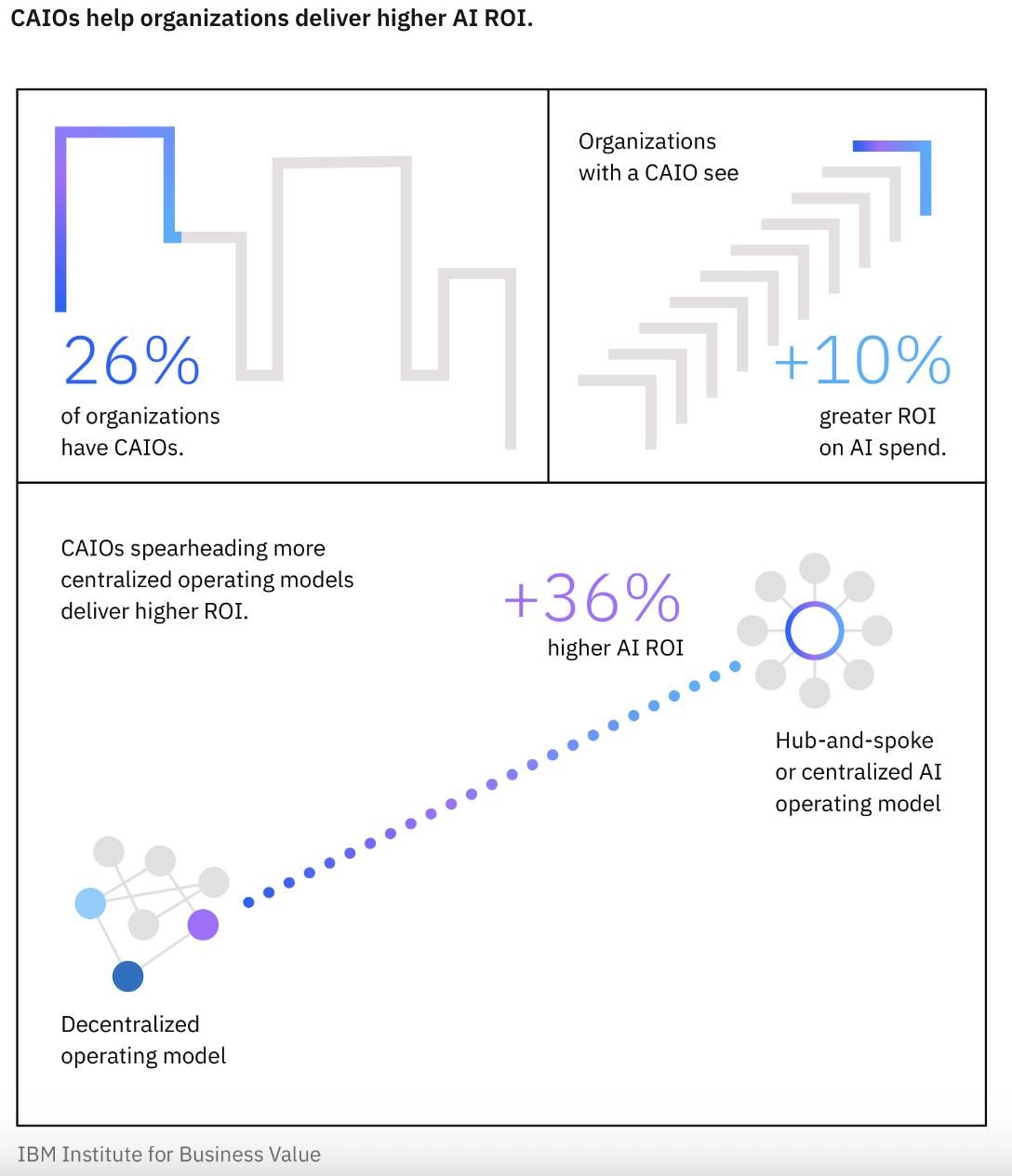
CAIOs are unlocking results. IBM.
The Chief AI Officer (CAIO) role has more than doubled in the last year, according to IBM research. Centralized AI operating models led by CAIOs move pilots to production twice as fast and achieve 36% higher ROI, driven by a clear CEO mandate and strategic investment. link
Converting interest into revenue for integrated solutions remains a challenge. Despite high marks for AI in customer support, fewer than 5% of Salesforce customers are paying for its Agentforce product, highlighting broader enterprise skepticism toward high-cost, third-party AI platforms. link
To measure real-world economic value, OpenAI introduced GDPval, a benchmark covering narrow tasks from 44 occupations worth $3T in annual wages. The initial results show frontier models are approaching human expert performance, with the best-performing AI winning or tying in nearly half of the evaluated tasks. link link
Anthropic’s latest Economic Index reveals uneven global AI adoption, with nations like Singapore and Canada showing high per-capita usage. The report also signals a behavioral shift, as direct task automation now drives a plurality of user interactions, with ‘directive’ conversations jumping from 27% to 39%. link
Headlines claiming “95% of Enterprise AI fails,” based on MIT’s NANDA survey, have faced scrutiny for shaky analysis. While the data is unclear, the underlying lesson holds: companies are logically and aggressively pruning AI pilots that do not demonstrate clear ROI. link
Leaders are navigating the cultural shift of AI integration. As Walmart President & CEO Doug McMillon stated recently, “Prioritizing people doesn’t mean that we can’t be great with technology…the combination…is the winning formula.” link
The Blueprint for Agent Success
To ensure agentic AI success, McKinsey’s QuantumBlack group advises focusing on fundamentals. Successful deployments begin not with the agent itself, but with well-defined standard operating procedures and a comprehensive evaluation framework to measure performance, build trust, and prove value from the start.link
At Fortune Brainstorm Tech, executives identified weak middleware and data infrastructure as the primary cause of AI rollout failures. Amex, for example, had to rebuild its data layer for a knowledge assistant after the initial system collapsed under messy, unstructured data. link
The Tech Matters: Differentiated Model Performance
While frontier models appear to be converging in capability, OpenAI’s GDPval benchmark, mentioned above, reveals distinct strengths. Claude Opus 4.1 was the top performer, excelling in formatting and multi-modal tasks, while GPT-5 demonstrated superior accuracy and instruction following. Gemini 2.5 Pro trailed both in the tests. link
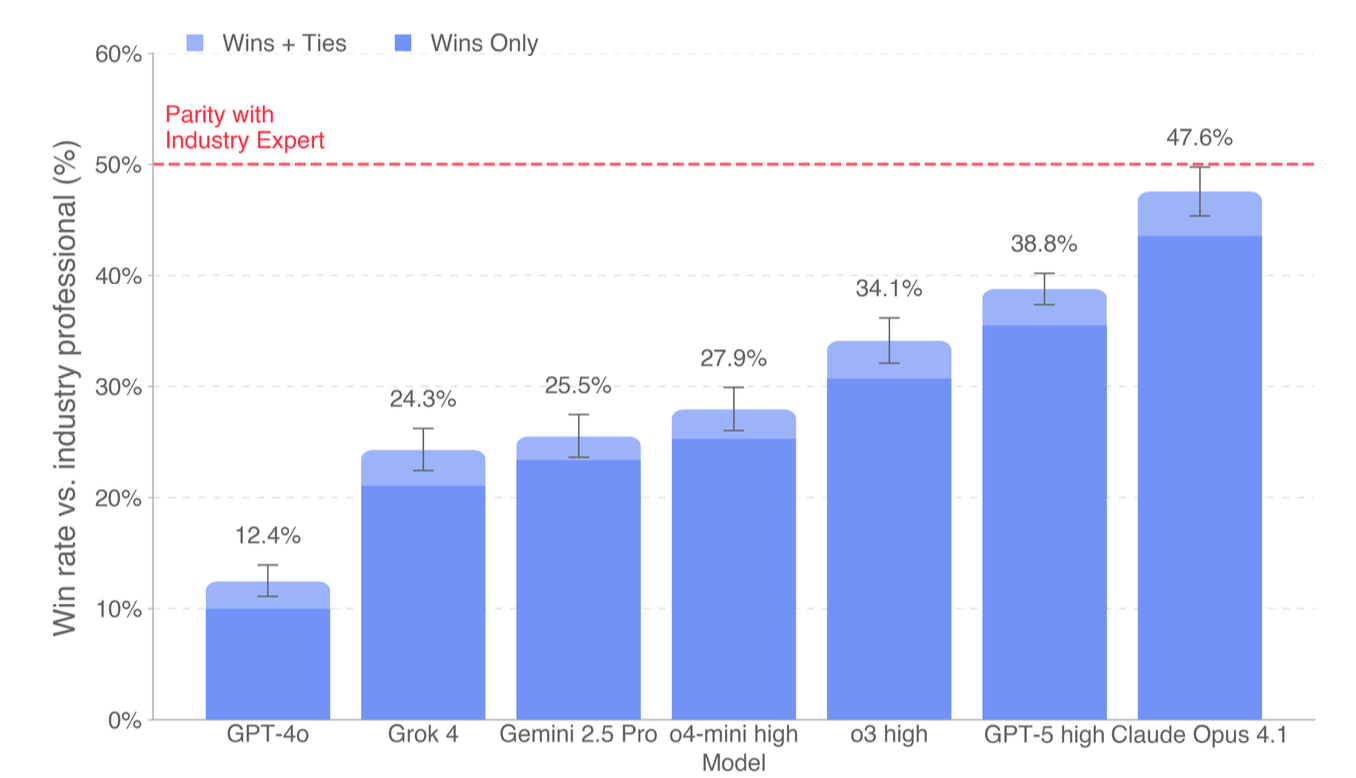
AI reaches near-parity on narrow real-world tasks, with model differentiation. OpenAI GDPval.
A key unlock for data accuracy is emerging with Vision RAG—the ability to interpret visually dense sources such as charts and slides. This capability is improving rapidly, with companies like Cohere making significant strides in faithfully extracting data from complex documents. link