June 2025 Newsletter: Beyond the Hype: AI Gets Strategic
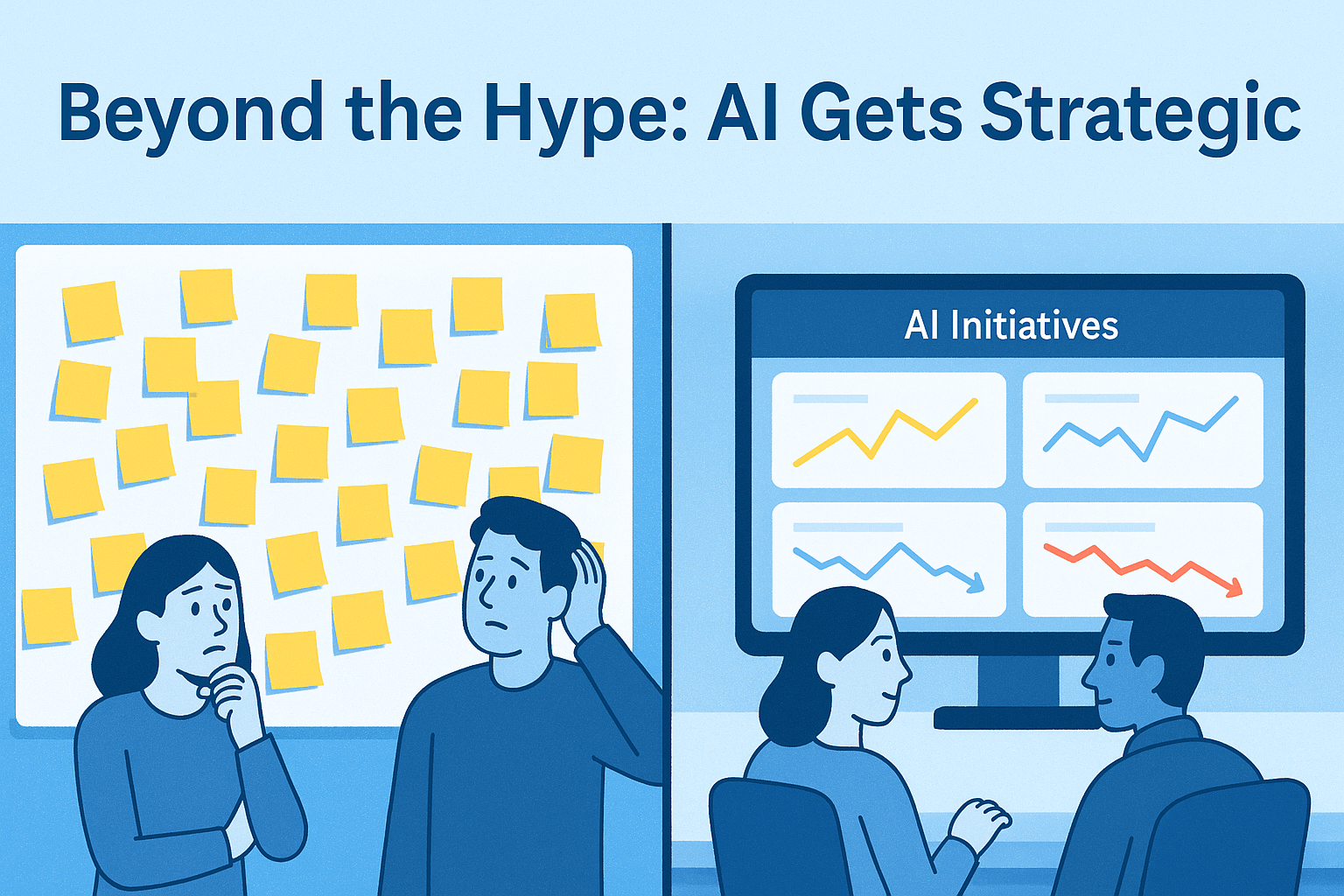
Beyond the Hype: AI Gets Strategic - ChatGPT-4o
Navigate the AI landscape with my latest newsletter. Get practical insights for executive decisions that deliver business value. To read my future editions subscribe here and ‘follow’ me on LinkedIn
Two and a half years since ChatGPT’s launch, we’re seeing clear signs of enterprise AI maturation. Companies are moving from experimentation to focus, marketing functions are being upended, and organizations have become more strategic about AI deployment. Amid model makers jostling atop LLM leaderboards, the only metrics that matter are those directly tied to business requirements.
From Disillusionment to Maturity
The Economist recently highlighted growing corporate “disillusionment” with AI, citing S&P Global research showing 42% of firms abandoning most AI initiatives versus 17% last year. The same study found 40% of companies expect company-wide AI systems by year-end versus 27% last year, while significantly trimming trials and POCs. J&J, discussed in an earlier newsletter, has focused on less than 10% of its original initiatives to concentrate on what delivers results. Sounds like maturity more than disillusionment. link
Klarna, which made headlines deploying AI for customer support, now acknowledges humans play an important role and has started rehiring support representatives to balance AI’s efficiency with human empathy. Meanwhile, 1-800Accountant uses AI to handle 65% of customer inquiries at human-equivalent quality with “abundantly clear” ROI. link
The Atlantic’s CEO Nicholas Thompson observed: “The closer you are to AI training, the sooner you’ll be disrupted” and “If you fight AI, AI will make your job worse sooner.” He’s remaking The Atlantic’s business model around AI while human writers remain at the magazine’s core. link
CompTIA reported 214,000 tech sector job cuts while AI-related job listings surge. IBM has replaced hundreds of human resource positions with AI while simultaneously hiring in sales and programming. link link
Marketing in the Age of AI
The Wall Street Journal reported that AI is disrupting digital advertising as users bypass traditional search. Apple revealed Google searches via Safari dropped recently, while Bain found 80% of consumers resolve 40% of search questions without clicking links. Companies like Mailchimp are redesigning sites to appeal to LLMs, but many CMOs remain unaware of needed optimizations. As Forrester’s Nikhil Lai noted: “SEO teams have been caught flat-footed.” link link
The pressure continues as Google doubles down on AI summaries. At I/O, CEO Sundar Pichai announced 1.5 billion AI Overviews users across 200 countries, with 10% growth in eligible searches and 65% annual increase in Google Lens visual searches. Users are happier.link
With AI efficiently generating marketing content, agency leaders like Sir Martin Sorrell at S4 Capital are shifting payment models from input (hours) to output (creative). CMOs recognize AI’s content creation efficiency and expect savings. link
Rules Make a Comeback
Companies are discovering optimal AI deployment strategies. Starbucks has succeeded by reverting to traditional decision trees—”if this, then that”—for managing in-store and mobile drink orders. United Health relies on complex rules-based software for auto-adjudicating 90% of claims, with AI assisting human adjusters by searching systems for missing documentation. link link link
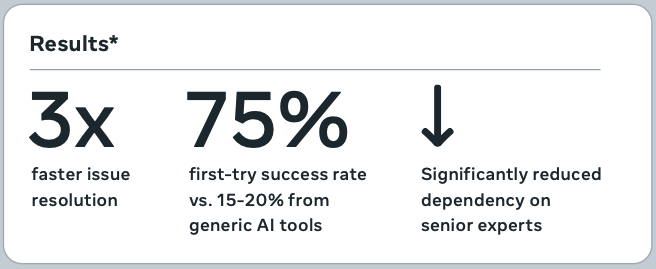
Aitomatic developed their Domain-Expert Agent (DXA), combining fine-tuned LLMs with codified expert processes for semiconductor fab field service. They’ve achieved 3x faster issue resolution and 75% first-try success rates versus 15-20% with off-the-shelf models. link
Test AI on your terms, not theirs
Meta’s Llama 4 launch sparked controversy. Simon Willison noted that “their leaderboard-topping model wasn’t the same one released publicly” and that Meta tested 27 private variants before release. Nathan Lambert noted that leaderboard performance does not necessarily translate to generalized performance since the models are specifically trained to ace the tests. link link
As Anthropic’s aims for the enterprise market, its Claude 4 release showed limited leaderboard improvements but claimed practical gains in coding, agentic workflows, and instruction following. link
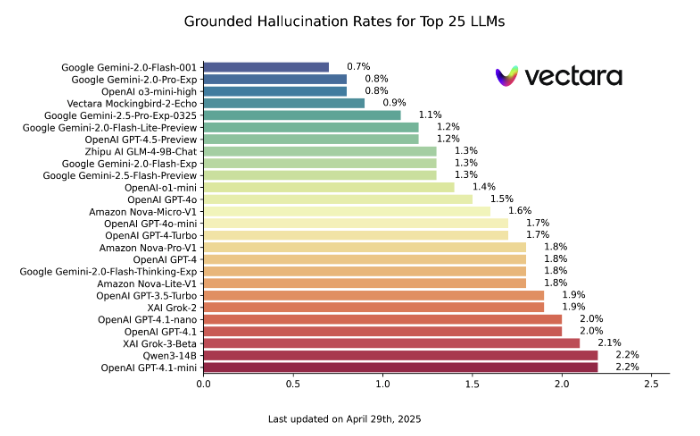
The New York Times reported increased LLM hallucination rates, driven by new multi-turn reasoning models. Vectara’s ongoing measurement since 2023 of a very common use case, Retrieval Augmented Generation, shows steady improvement in hallucination rates, with Google Gemini-2.0-Flash-001 at 0.7%, while reasoning models OpenAI o3 (6.8%) and DeepSeek R1 (14.3%) score higher. link