July 2025 Newsletter: AI Training Gets Legal Validation

AI Training Gets Legal Validation - ChatGPT-4o
Navigate the AI landscape with my latest newsletter. Get practical insights for executive decisions that deliver business value. To read my future editions subscribe here and ‘follow’ me on LinkedIn
This month brought clarity to enterprise AI strategy on two fronts: legal validation for model training and strategic focus on where to compete versus outsource. —
Enterprise AI Finds Legal Footing and Cost Focus
Federal Judge William Alsup ruled that Anthropic’s use of books for model training constitutes legal fair use. The decision clarifies that LLMs trained on legally obtained books generate transformative outputs, providing enterprises comfort around leading model legitimacy. link
Supporting public domain access, Harvard released one million books comprising 394 million pages through its Institutional Data Initiative, funded by Microsoft and OpenAI. link
Given economic uncertainty, CEOs focus on cost reduction via AI. BCG identifies four high-potential areas: codified knowledge, customer interactions, supply bases, and field forces. Surveying 10,000 workers, BCG found 72% using AI with 47% saving over one hour daily. link link
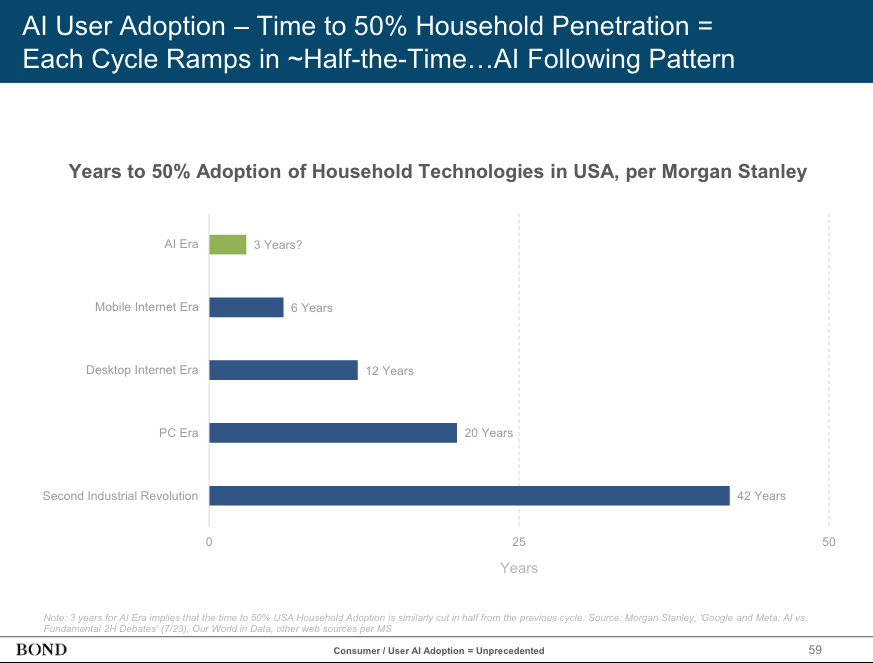
AI adoption is unprecedented
Mary Meeker returned to publishing with “Trends - Artificial Intellegence” emphasizing the “unprecedented” nature of AI. link
Where AI Delivers Real Business Value
McKinsey found 80% of companies have deployed AI initiatives, yet the same proportion see little profitability impact. While foundational uses like chatbots and MyGPTs are widespread, vertical applications deliver real value — though technical, organizational, data, and cultural barriers challenge progress. link
Reinforcing this finding, Andreessen Horowitz’s survey of 100 CIOs reveals companies increasingly rely on third parties for commoditized use cases like data analysis, enterprise search, and customer support. Enterprises should reserve limited internal AI resources for building differentiated, company-specific applications. link
Apple’s experience illustrates the challenge. Despite excitement around “Apple Intelligence,” Bloomberg reports the tech giant delivered “meager new AI enhancements.” As Bryan Bischof noted: “You can’t roadmap what hasn’t yet been discovered.” AI product development requires hypothesis testing with strong evaluation discipline. link
A key to company-specific applications is evaluating the unique functionality. The advertising giant IPG uses AI for copy generation and has developed assessments through its Kinesso arm to measure text uniqueness across models; the more unique the LLM output, the better. link
Model Competition Intensifies Amid Funding Pressures
The A16Z CIO survey confirms user preferences: OpenAI, Gemini, and Anthropic lead model usage and deployment, with GPT-4o as the most deployed model. Gemini has gained ground with its 2.5 models and Claude is a favorite for coding. link
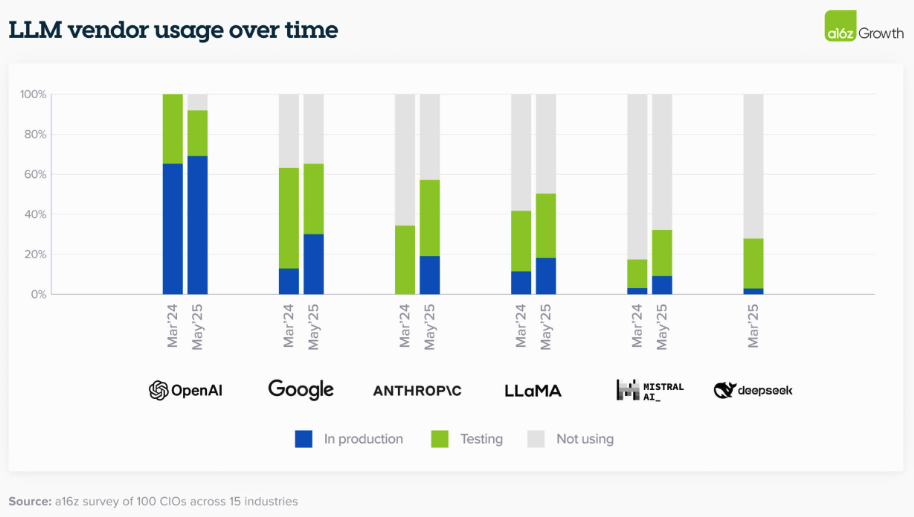
ChatGPT, Gemini, and Anthropic lead the way
After a disappointing Llama 4 launch, Meta CEO Mark Zuckerberg is spending aggressively on AI efforts, including a 49% acquisition of Scale.ai and hiring AI leaders Daniel Gross and Nat Friedman. These moves should benefit the open-source AI movement. link
Meanwhile, xAI faces revenue challenges, reportedly burning $1 billion monthly. The company raised $10 billion in debt and equity, providing runway through 2025. link link