December 2025 Newsletter: From Pilots to Production: Scaling AI with Intent

Image: Gemini 3 Pro
Somebody is buying all those AI cloud services (and it’s starting to pay off)
Wharton and GBK Collective identify a new era of “accountable acceleration.” 82% of leaders use GenAI weekly, and 72% formally measure ROI—with three-quarters already seeing positive returns. As CAIOs join 60% of enterprises, firms are pivoting to custom capabilities, allocating one-third of budgets to internal R&D. link
Shifting the focus of AI success measurement from project ROI to financial impact, McKinsey finds that 80% of companies report no material contribution from GenAI even though adoption is rising. Firms are seeing 30–50% reductions in time-to-hire and 25–60% boosts in ad engagement. link
Meanwhile, Bain & Company reveals a shift from experimentation to value 40% of software development pilots are now scaling. While data security remains the primary barrier (45%), eighty percent of AI use cases met or exceeded expectations, with agentic automation projects performing twice as well as basic assistants. link
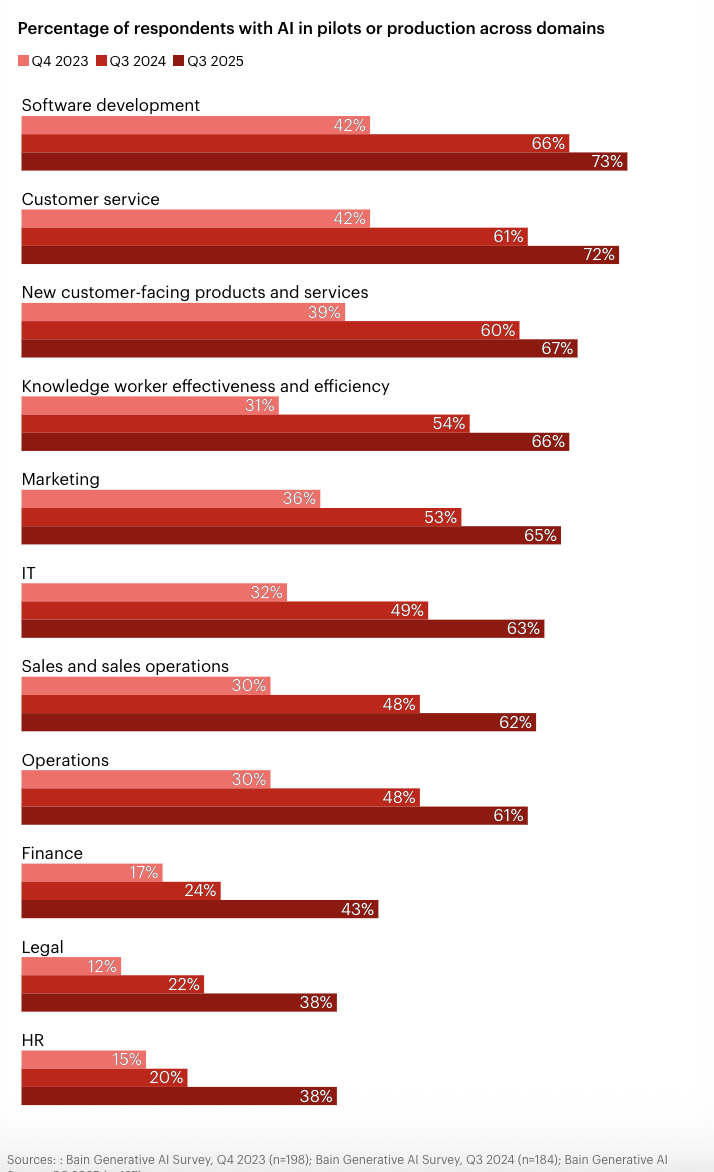
AI pilots and production are expanding across all functions. Source: Bain
The bottom line on enterprise AI usage is that major cloud and AI providers are growing dramatically. According to CNBC, Microsoft’s Azure revenue surged 40%, Google Cloud sales rose 34% to $15.15 billion, and AWS grew 20% to $33 billion. All three are doubling down on infrastructure to meet demand. link, link
A secret to AI implementation success: listening to users
LVMH attributes its AI success to “listening to business priorities” rather than pushing technology. According to The Economist, the luxury giant embraces the “J-curve,”where costs rise before returns, to prioritize revenue growth and customer experience over cost reduction. link
IKEA is applying its flat-pack model to AI by modularizing tools into “shared kits” for local teams to assemble. Also according to the Economist Impact, this approach empowers workers and flips resistance into insight, ensuring AI augments rather than replaces roles. link
Booking found success implementing AI support for partners by prioritizing efficiency and keeping humans in the loop. By building comprehensive evaluation pipelines, the travel giant effectively minimized misinformation and boosted user satisfaction in live pilots. link
OpenAI further emphasizes the critical role of “evals” at every development stage — scaling requires a “Specify, Measure, Improve” framework. This rigor helps organizations transition from experimental pilots to reliable, production-ready AI systems. link, link
“AI will never save bad leadership.” HFS Research offers a six-part framework and real-world examples showing how executives must adapt their management styles to lead effectively through the AI transition. link
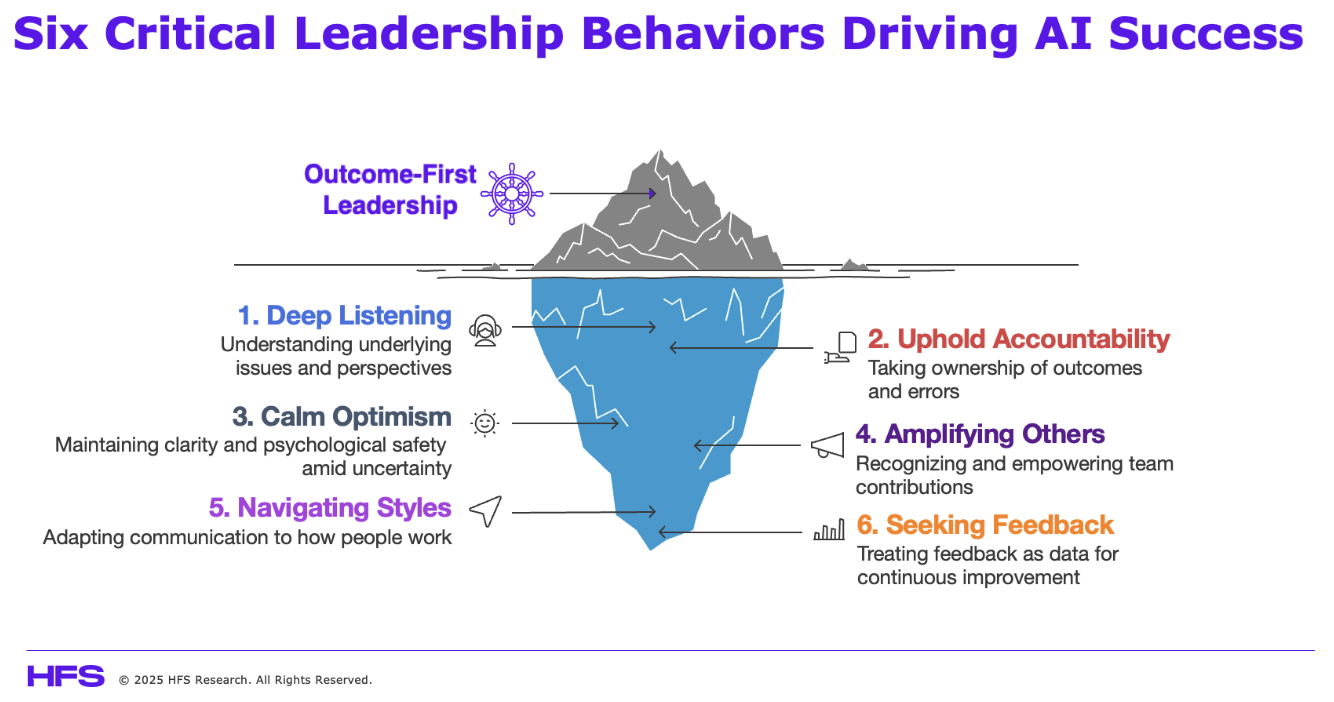
6 Critical leadership behaviors driving AI success. Source: HFS
The Rise of GEO: Optimizing for the $750B AI Search Market
McKinsey reports that 50% of consumers already use AI search, with $750 billion in revenue expected to flow through these channels by 2028. To win, brands must adopt “Gen AI Engine Optimization” (GEO), as Google’s Gemini, for example, currently prioritizes affiliate blogs over brand sites for key product categories. link
Indeed, Semrush reports that Reddit and Wikipedia remain top-cited AI sources, even after their citation frequency on ChatGPT dropped dramatically in September 2025. link
Advertisers are responding. According to Adweek, companies are targeting Reddit to indirectly gain AI recommendation favorability. link
“Code Red”: Google Gains Ground While Open Source Closes the Gap
Google is gaining ground, reporting 650 million monthly Gemini users against OpenAI’s 800 million weekly. With Google also launching Gemini 3 and Nano Banana Pro, a tool offering “studio-quality” control, Business Insider says Sam Altman declared a “code red,” scrambling to bolster ChatGPT. link, link
According to Moonshot AI, its new open-source Kimi K2 Thinking model surpasses GPT-5 on reasoning benchmarks like Humanity’s Last Exam. This release underscores the narrowing performance gap between proprietary US models and Chinese open-source alternatives. link
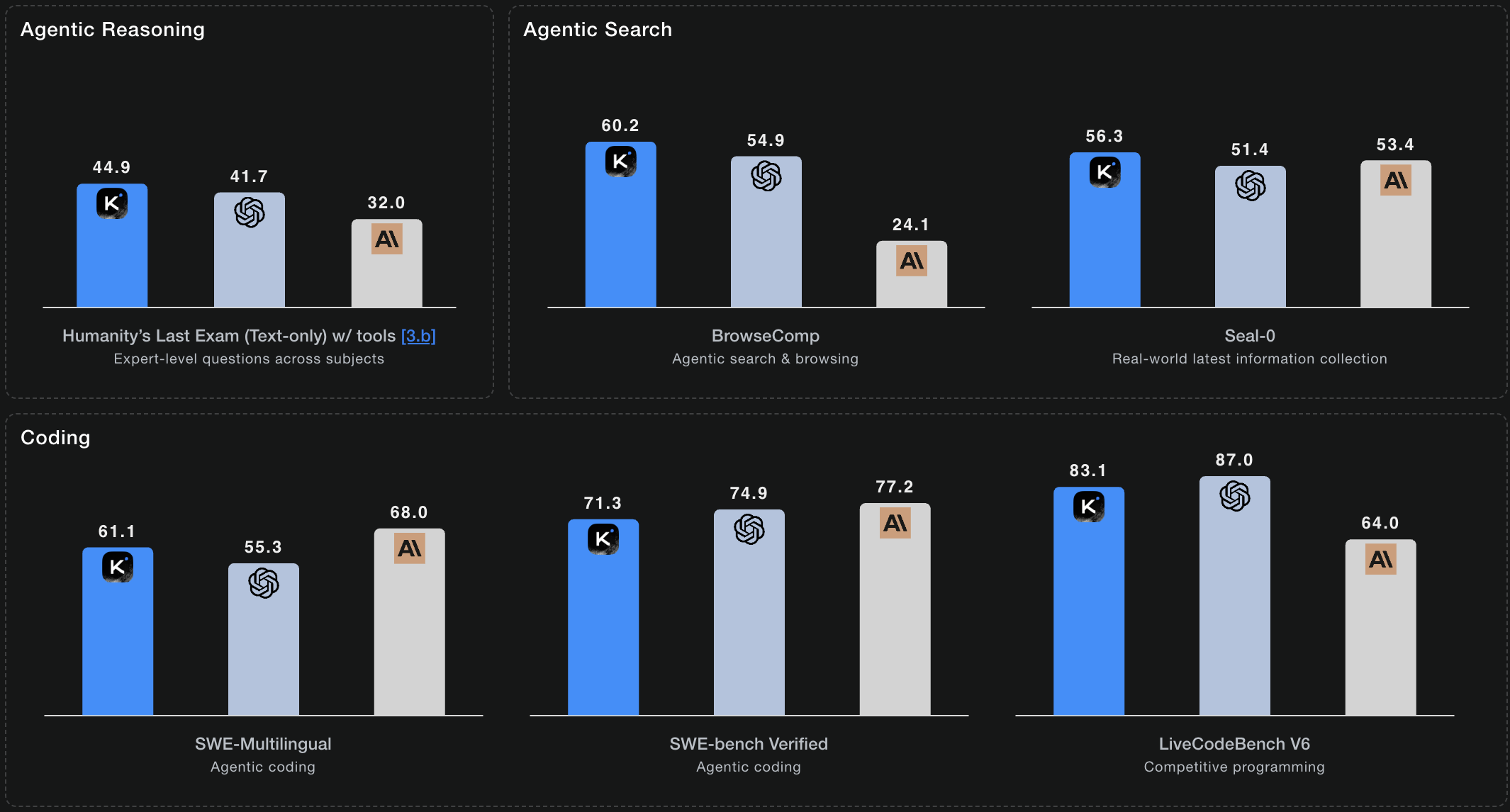
Kimi is catching up. Source: Moonshot AI
Explicitly citing the “rise of AI,” Google and AWS jointly engineered a multi-cloud networking solution under an open specification. As reported in Stratechery, the service establishes private, high-speed links between the rival clouds to support specialized accelerator resources and agentic applications. link
Despite all the model advancements, AI thought leaders believe AGI is still 5-10 years in the future, requiring new algorithmic paradigms. “It’s very difficult to make sense of how the model, on the one hand, does these amazing things, and on the other hand, repeats itself twice…” Ilya Sutskever. link