August & September 2025 Newsletter: AI Hiring Trends Risk a Future Talent Gap
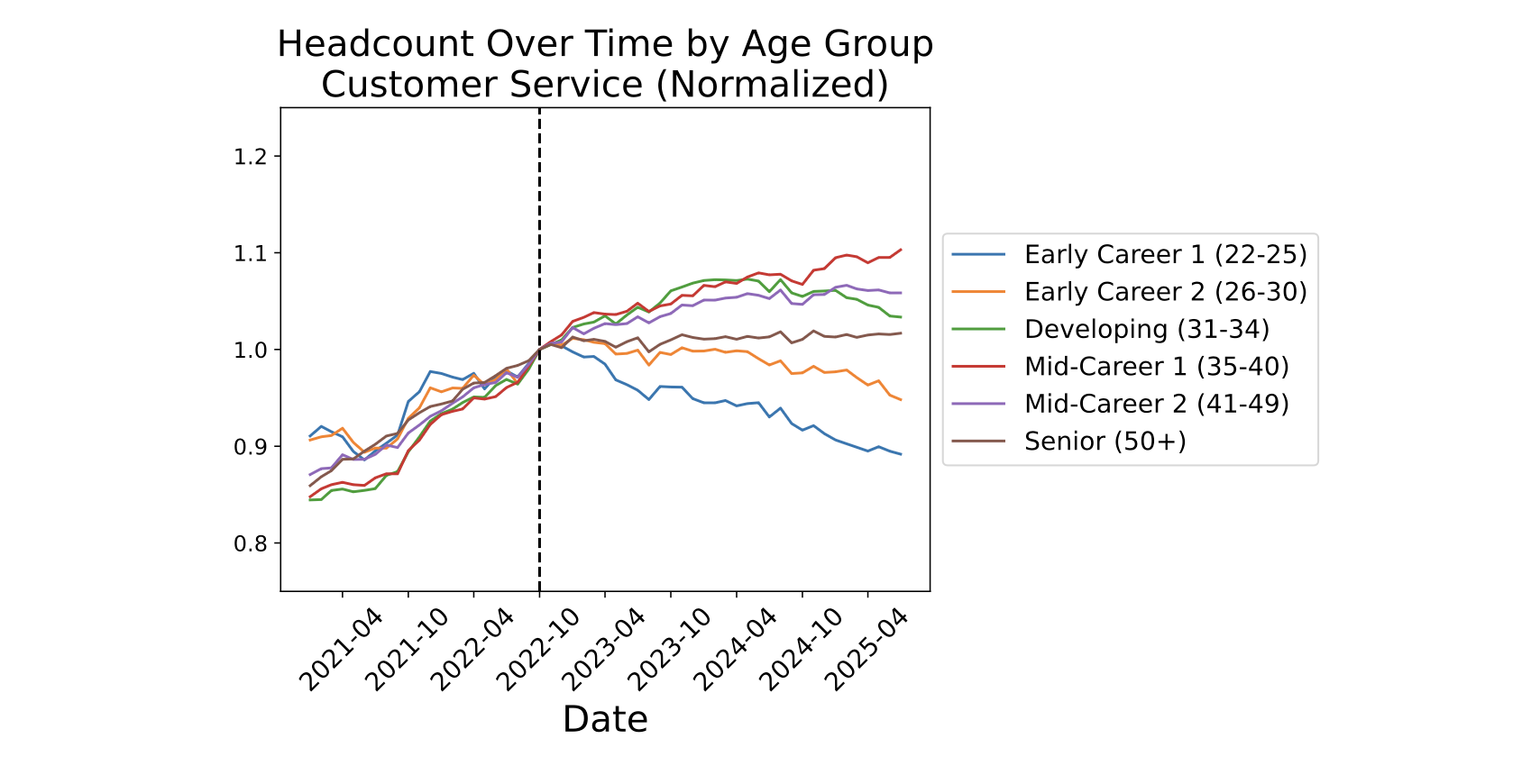
Employment impact by age cohort - Customer Service - source: Stanford "Canaries in the Coal Mine"
Navigate the AI landscape with my latest newsletter. Get practical insights for executive decisions that deliver business value. To read future editions, subscribe here and follow me on LinkedIn.
AI hiring trends risk a future talent gap
As the author of this newsletter and an advisor at the intersection of business and technology, I focus on using AI for enterprise good—doing things better, faster, and more productively. But as a builder of teams and a father, I’m concerned about AI’s impact on early‑career hiring. Recent analyses from Stanford and McKinsey point to declines in postings and hires for entry‑level roles with high AI exposure—especially where junior work overlaps with tasks AI can now handle.
Using AI to cut costs and restructure is rational—but starving the junior pipeline means tomorrow’s expertise never materializes. After the late‑’90s consulting bust, junior de‑layering created a years‑long talent gap within firms.
I see two imperatives:
- Employers: Redesign roles around AI, invest in apprenticeships and on‑the‑job training, and hire and retain for initiative, judgment, and collaboration—not just tool familiarity. Balance workforce capability and tenure.
- Students and early‑career professionals: Master relevant AI workflows and data literacy, and double down on durable advantages—critical thinking, clear writing, design sense, and interpersonal skills.
Make apprenticeship two‑way: juniors help mid‑ and senior‑level colleagues build AI fluency; veterans pass on business judgment and people skills. We can’t automate the first rungs and still expect seasoned leaders at the top. link link link
Managing risk and results
Executives see AI risks as urgent. A 2025 MIT Sloan study reports that 82% of leaders cite data security and privacy as their top concern. Anthropic’s 2025 threat report also highlights misuse, with reported incidents of criminals using Claude for fraud and ransom demands exceeding $500,000. To mitigate misuse, Netflix released AI content guidelines requiring approval for use cases involving talent likeness, copyrighted works, or sensitive data.
An MIT–McKinsey study finds AI leaders achieve 3.8× more impact through active executive sponsorship and pruning. UBS projects $375 billion in AI infrastructure spend in 2025, while The Information reports AI‑native apps already generate $18.5 billion annually. link link link
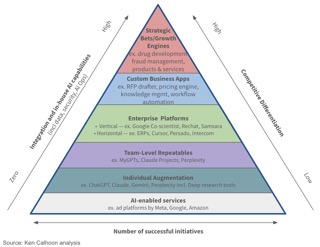
Unable to find a single graphic that effectively frames the ways enterprises can utilize AI, I created one.
The Enterprise AI Pyramid plots AI work on three axes—(1) how deeply you integrate and govern it, (2) how much competitive advantage each layer can create, and (3) how many projects you can realistically keep alive. See the full explanation link.
Enterprises redefining AI leadership are seeing improved results. IBM research suggests only 26% appoint a Chief AI Officer, yet these firms achieve roughly 10% higher ROI on AI investments. When CAIOs implement centralized or hub‑and‑spoke operating models, ROI jumps about 36% versus decentralized setups—evidence that broader control aligned to business outcomes drives impact. link
Working on workflow
A recent Bain & Company report finds 72% of CIOs view workflow automation as the most promising use case for agentic AI. BCG cites examples like a biopharma company using GenAI to draft clinical documents, improving efficiency by 30%–40%. And LangChain emphasizes that designing a detailed standard operating procedure is a critical first step for building reliable agents. link link link
MIT’s State of AI in Business 2025 reports that only 5% of GenAI pilots reach production. The other 95% stall when real‑world friction exposes brittle workflows and shallow integrations. The lesson isn’t to eliminate friction but to design for it—bake in governance, memory, verification, and learning loops so tools adapt to variation and fit daily operations. link link
Brand‑direct ad spend has tripled since 2019 to roughly 30% of the U.S. market, while Unilever reports using in‑house tools to cut ad production time by ~30% and to double video completion rates and click‑through rates (per Digiday and VideoWeek). link link
Factories of the future
To build competitive edge, Walmart invested in Element, an AI factory that standardizes architecture and data—skirting traditional build‑vs‑buy trade‑offs. In year one, Element enabled dozens of GenAI apps, initially reaching 50,000 associates and now expanding toward 1.5 million employees globally. link
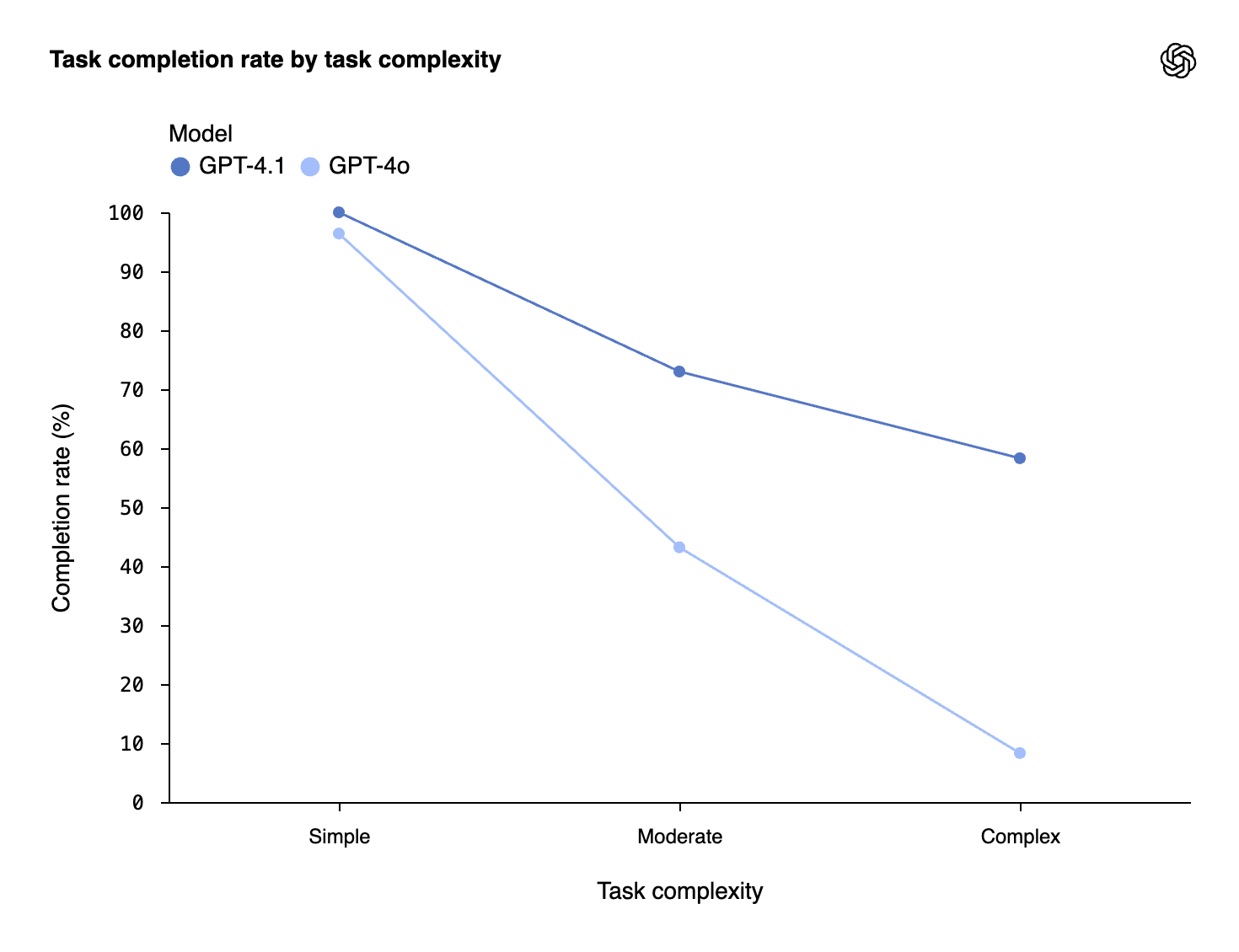
Evaluations-based accuracy improvement - Intercom
Intercom illustrates the value of rigorous evaluations. The team uses a model‑agnostic architecture and constant experimentation guided by a gold‑standard dataset. They report switching to GPT‑4.1 within 48 hours after internal tests showed ~70% accuracy and about 20% lower cost. link
Incremental model gains
According to The Information, OpenEvidence scored 100% on a U.S. medical exam benchmark, while OpenAI’s GPT‑5 scored 97% and has hired a VP to go after the healthcare space. Performance is weaker in finance: Penrose’s AccountingBench shows that Claude 4 and Grok‑4—top LLMs on the task—drift to ~15% error rates after several months of pro‑forma closings. link link
Progress is mixed in critical enabling modalities. Google’s Gemini introduced the “Nano Banana” image editor, reportedly topping leaderboards for precise incremental edits. OpenAI launched gpt‑realtime, an upgraded speech‑to‑speech model with improved function calling and instruction following, though multi‑turn accuracy remains a challenge. Computer‑using AI agents—which operate software via UIs and APIs, including legacy enterprise systems—hold strong promise, but a16z cautions that broad deployment will require significant vertical-focus and deep context to handle customized ERP environments. link link link link
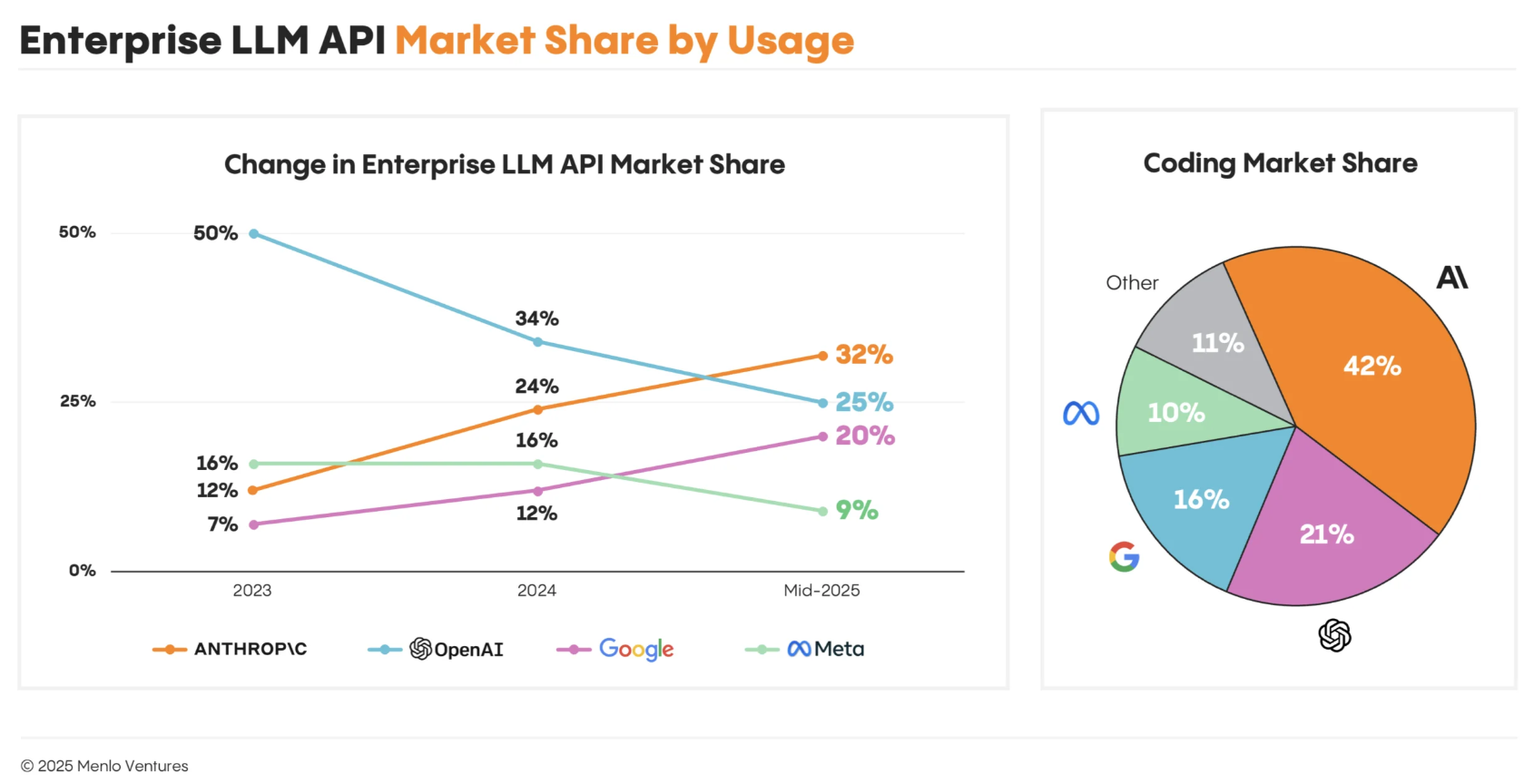
Anthropic takes the lead in enterprise adoption - Menlo Ventures
Enterprise LLM spend hit $8.4B in H1 ’25—already more than double 2024—per Menlo Ventures. Anthropic leads enterprise usage at 32%, buoyed by coding performance. The firm separately notes that model changes are mostly based on performance improvements, not cost. OpenAI launched GPT‑5 with automated model routing, formalizing features power users previously assembled themselves. It also released its first open‑weight models since GPT‑2, bolstering the open ecosystem while navigating consumer–enterprise trade‑offs amid intensifying global competition. link link link link
—–
If you found this useful, subscribe to future editions here and follow me on LinkedIn.