AI Is Graduating from Pilots to Production — and the Data Shows What Separates Leaders
Bain’s longitudinal AI executive survey found that 80% of generative AI use cases met or exceeded expectations — yet only 23% of companies can tie those initiatives to measurable revenue gains or cost reductions. That gap defines the current moment.
Source: Bain
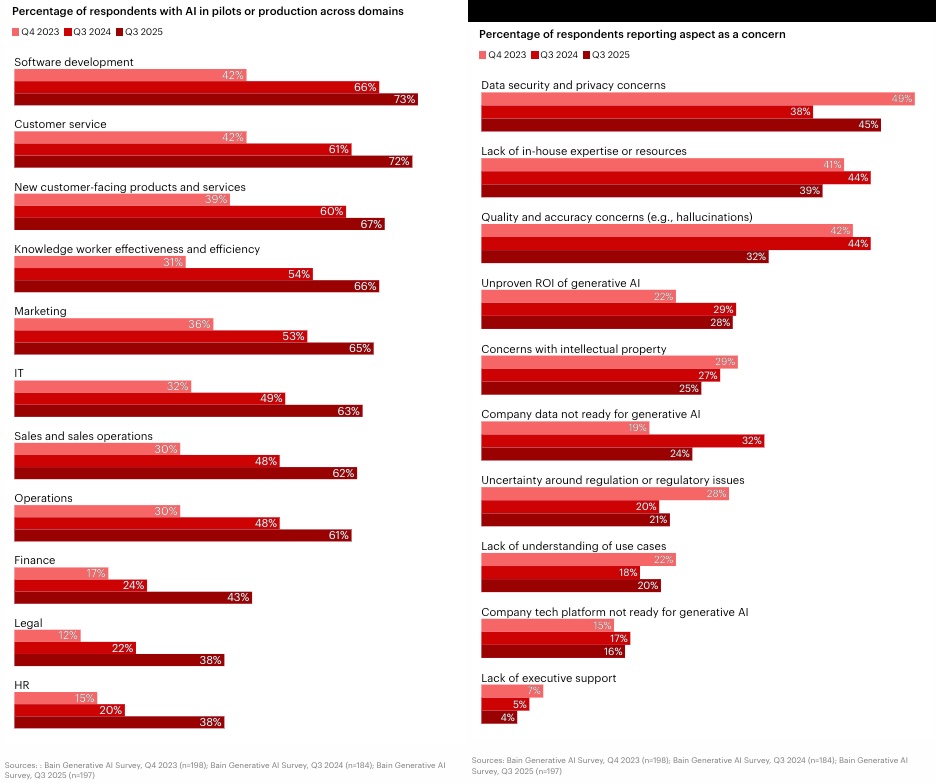
The broader shift is accelerating: 74% of firms now rank AI a top-three strategic priority, up from 60% a year prior. Software development leads production scaling at 40%, customer service at 32%. In my client work, I see the same compounding dynamic — capabilities built for one function, say knowledge retrieval or invoice processing, transfer to others at lower cost and risk. Scale breeds scale.
Satisfaction rises sharply as companies move from AI-as-assistant to agentic workflow automation. Bain found respondents using agentic approaches were twice as likely to report results exceeding goals. But the risk profile shifts with it: security and privacy concerns climbed from 38% to 45% year-over-year, spiking to 49% among companies in production versus 35% still piloting. Automation unlocks the upside — it also demands tighter governance.
When use cases disappoint, the model is rarely the problem. Bain found a third of failures scaled poorly because designs didn’t accommodate real-world data and workflow complexity. Capturing those intricacies upfront — through shadow deployment and gradual rollout — separates durable production from a stalled pilot.
Leading firms share a common posture: defined vision, prioritized use case list, dedicated investment, and an iterative roadmap. Bain found 55% of leaders have all four in place, versus 40% of laggards who lack even a defined vision. The discipline isn’t just planning — it’s maintaining focus on shipping current initiatives while systematically identifying the next wave. That compounding effect is where the real ROI emerges.