The Chief AI Officer Advantage: Deconstructing the 36% ROI Lift
With CAIOs in centralized models doubling AI production rates and achieving a 36% higher ROI, it’s clear why the role’s adoption has doubled to 26% in the last year. New research from IBM’s Institute for Business Value breaks down this trend. link
This is the formalization of a critical role I’ve seen firsthand over the past decade as an ML and AI translator. Success has always hinged on bridging the gap between business goals and technical execution. The CAIO role makes this translation function official, empowering it with the mandate to ensure real value is created at scale.
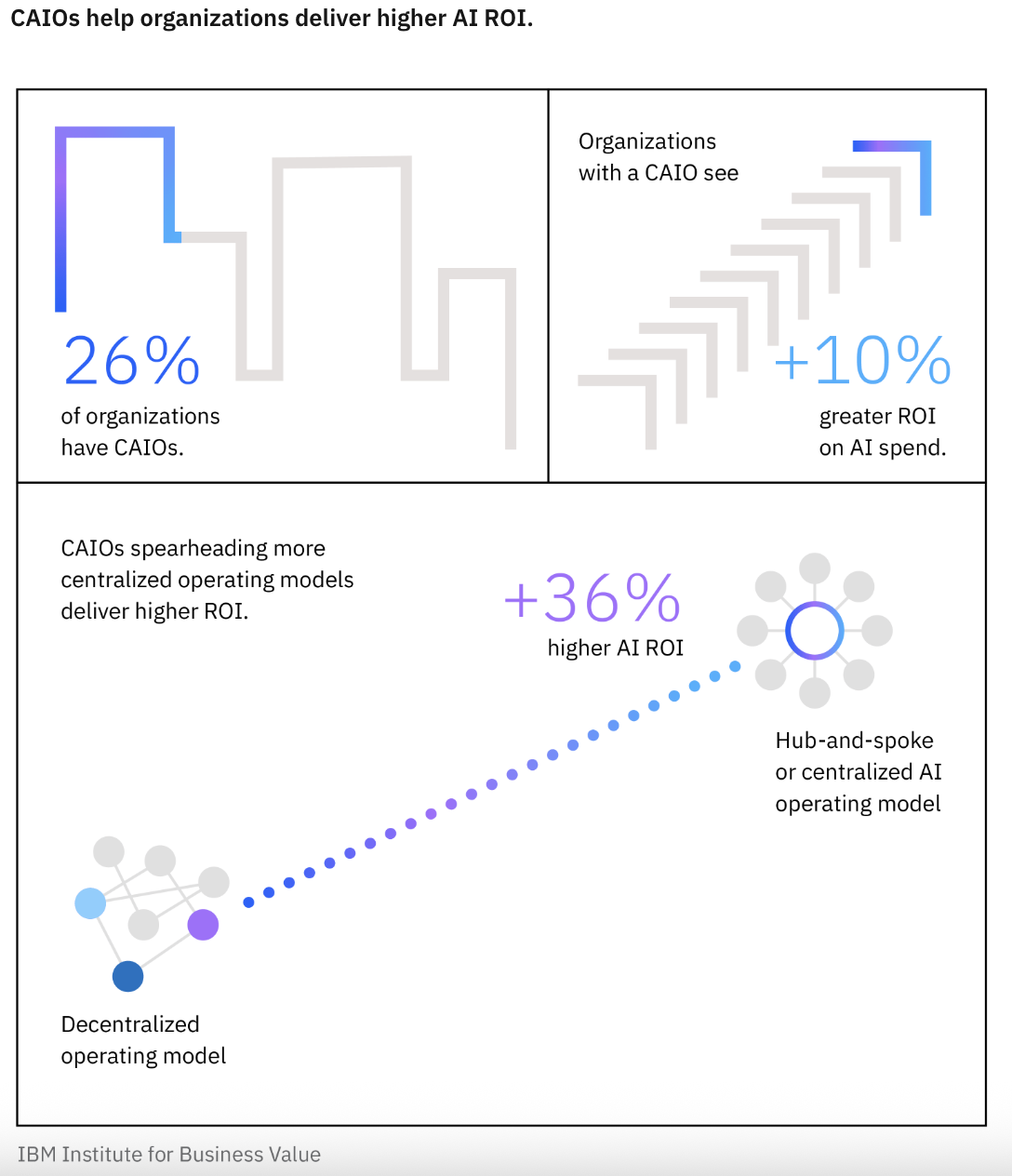
CAIOs with a centralized/hub-spoke model drive 36% better AI ROI
Structural keys to CAIO success:
-
They have a direct mandate. With 57% of CAIOs reporting to the CEO or the Board and 61% controlling the AI budget, they have the authority to break down silos and enforce a coherent strategy. This is a shift from influence to direct ownership.
-
They centralize for impact. The CAIO role signals a move away from decentralized scattered, disconnected experiments. By implementing centralized or hub-and-spoke operating models, they build the focus and governance required to turn powerful technology into a durable competitive advantage.
-
They balance rigor with intuition. The CAIO must manage a core tension. IBM notes that while 72% of executives know their firms risk falling behind without proper AI impact measurement, 68% of CAIOs will still initiate projects based on instinct if the strategic value is high. This requires a leader who can build a business case but also knows which bets to place before the ROI is perfectly clear.
The takeaway: The CAIO is not just an individual. Their success signals the adoption of a more mature, centralized, and accountable operating model for AI—one that is built on the crucial function of translation between business and technology.