Leading companies apply portfolio theory to AI investments
Most companies form business strategy around a portfolio of investments and activities. Executives strive to grow consistently by maximizing existing businesses through enhancements and efficiency improvements while investing in innovative, high-growth opportunities for the future.
As AI transitions from experimental to operational, we’re seeing investments across this continuum.
Jon Victor provides a helpful chart in his Applied AI newsletter organizing 30 AI applications from Widely Adopted to Experimental. Applications on the right cover universal functions like customer support and marketing, while those on the left are domain- and company-specific.
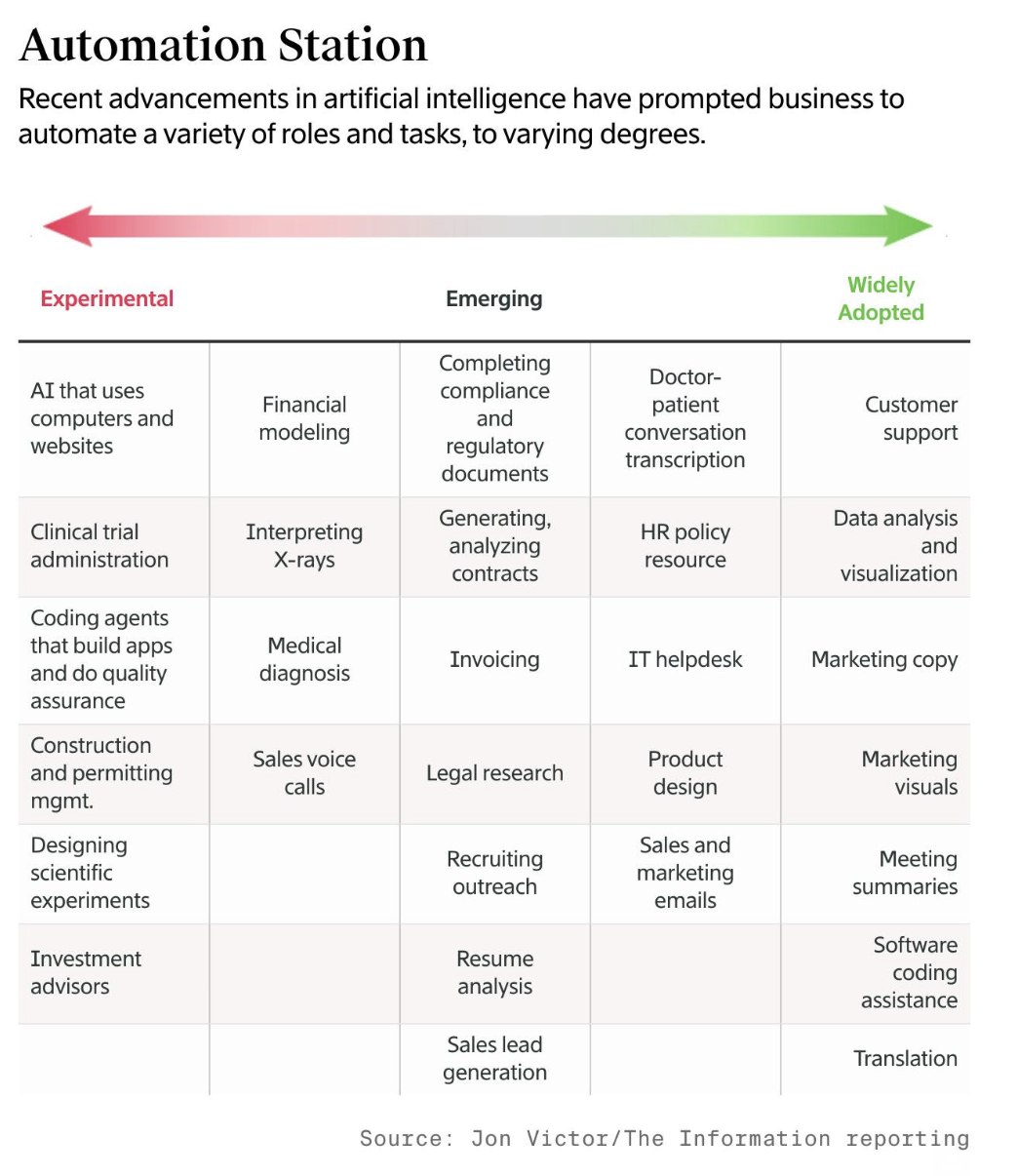
Leading companies aren’t making isolated AI bets—they’re investing in projects yielding returns both today and tomorrow. Executive teams should assess AI initiatives with four questions:
- How do our AI activities map on this grid?
- For the Widely Adopted applications, are there any we’re missing and why?
- How many strategic bets (projects to the left on the diagram) are we making?
- “Does our AI investment mix optimize immediate returns and future opportunities?”
Johnson & Johnson exemplifies a balanced approach. In a recent Wall Street Journal piece, CIO Jim Swanson described initiatives enabling employees (sales coaching with Rep Copilot), improving operations (organizing clinical trials), and making strategic bets (drug discovery) for future growth.
For those embracing the technology, AI is a critical element for portfolio strategy execution.