The Enterprise AI Pyramid
The Enterprise AI Pyramid
Unable to find a single graphic that effectively frames the various ways enterprises can utilize AI, I created one. The Enterprise AI Pyramid plots AI work on three axes — (1) how deeply you integrate and govern it, (2) how much competitive advantage each layer can create, and (3) how many projects you can realistically keep alive. Read bottom-to-top for a roadmap; scan the arrows for the trade-offs.
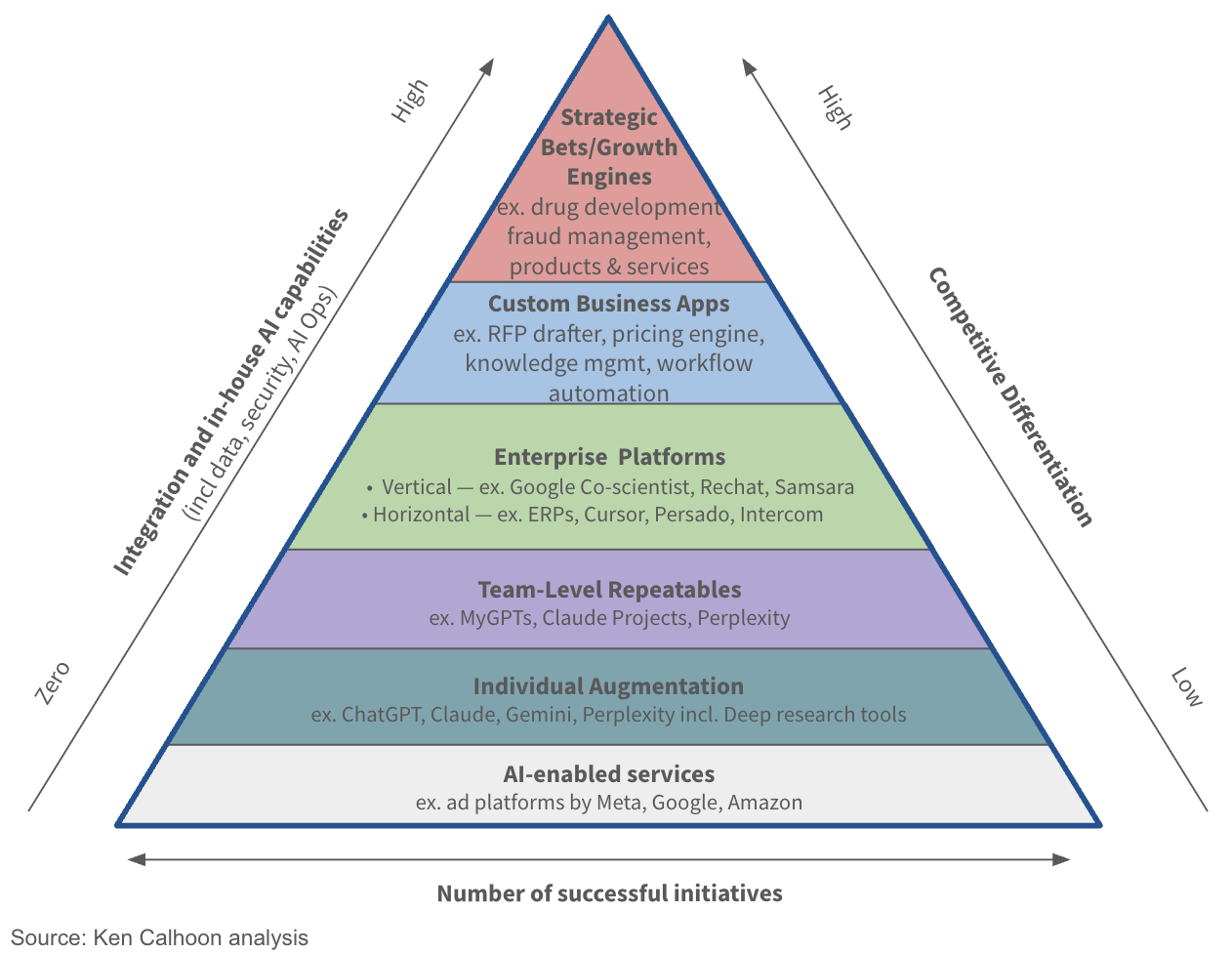
Layer Snapshots
| Layer | Litmus Test | Implementation Examples |
|---|---|---|
| AI-Enabled Services | Vendor owns model & data; near-zero internal integration | Google’s AI-powered ad products show measurable lifts: Performance Max automates ad bidding and placements for +8% Return on Advertising Spend (ROAS), while Demand Gen expands the funnel by finding new customers for +10% ROAS on top of Performance Max and Search campaigns (Nielsen case study, 2025). |
| Individual Augmentation | Ad-hoc interaction & limited repetition; human rework required | Procter & Gamble found AI-assisted teams, with little AI training, worked 12% faster and reported higher creative quality and morale (Fortune; P&G blog; SSRN preprint). |
| Team-Level Repeatables | Shared prompt/MyGPT; 95%+ first-pass quality; limited scope | Moderna employees built thousands of tailored GPTs (e.g., for dose-selection write-ups and regulatory responses), turning ad-hoc prompting into reusable team workflows (WSJ; OpenAI). |
| Enterprise Platforms | Platform capabilities, including privacy & security, outweigh deep customization and lock-in concerns | SAP has launched dozens of Joule AI agents across many business functions — sales support and customer service see 50% productivity improvements (SAP News Center). Cursor’s horizontal coding platform meets enterprise security needs with single sign-on, role-based access control, and privacy mode (Cursor Enterprise). Rechat’s “Lucy” vertical real estate platform unifies CRM, marketing, and transactions (RISMedia). |
| Custom Business Apps | Enterprise-specific integration or functionality unavailable off-the-shelf; BU owns and funds | Zurich’s copilot summarizes disparate information sources and saves 60 minutes per underwriting submission (Zurich NA release). Holcim, a 122-year-old building materials company, built a WhatsApp-based cement ordering system with 93% adoption and 66% order acceptance (McKinsey). |
| Strategic Bets / Growth Engines | C-suite sponsored; defensible data moat; multi-year horizon | Johnson & Johnson is investing in AI to deliver 50% more efficient surgeon training (Polyphonic), 2.6x accelerated clinical trials, and a 15% reduction in atrial fibrillation ablation procedure time (CARTO-3) (CIO). Deloitte’s Zora finance agents leverage the firm’s accounting expertise, delivering productivity improvements of 40% and potentially cannibalizing its core business (Deloitte). |
Reality check: Every AI journey is messy; no framework captures all the zigzags. Treat the Pyramid as a compass, not a Gantt chart. Like a summer hike, there are many paths to the summit, but a clear destination beats wandering.
Three Rules for a Winning Enterprise AI Strategy
1. Begin at the base — build culture, capability, and ownership
P&G’s experiment opening up ChatGPT to its teams is a critical step in developing cultural support for AI usage. Moderna scales up usage, invests, and ensures that clever use of AI is an expectation, not an option. J&J has devolved AI ownership away from the center and into its business functions.
2. Anticipate rapid change — double down on data, APIs, and scarce talent
What takes bespoke code this quarter may be productized next quarter. Smart companies remain flexible while doubling down on what is proprietary. Deloitte has codified its data to deliver new, competitive products. Walmart has created an AI foundry called Element that dramatically accelerates and standardizes AI development while avoiding model lock-in (Walmart).
3. Maintain a disciplined portfolio — prune fast, scale faster
Johnson & Johnson found that 10–15% of its ~900 Gen-AI pilots delivered ≈80% of the value and killed the rest, freeing capital and talent to scale the winners. Channel those gains into a few high-potential bets.
Conclusion — The Enterprise AI Pyramid as a Guide
The Pyramid packs a lot into one image. Strategically, it shows leaders where AI can sharpen competitiveness; tactically, it helps teams categorize work, track ROI, and sequence projects that build enduring cultural acceptance and technical muscle. The Pyramid is dynamic, with model makers and others continuously introducing new products and capabilities, requiring ongoing assessment and recalibration.