Is AI project abandonment bad?
Klarna recently announced that their effort to deliver customer support mostly via AI went too far, and they are hiring human support staff to augment AI’s speed and efficiency with empathy. The Economist wrote a piece discussing disillusionment with AI, citing S&P Global data that 42% of firms were abandoning most of their AI projects vs. 17% last year.
Sounds ominous, but it’s not necessarily. Poor projects being abandoned is good; valuable projects being shelved is bad. What’s going on?
Johnson & Johnson is a good example. Like many companies, they initially spread AI efforts far and wide, generating 900 projects. They recently pulled back to less than 10% of that total, narrowing down to a balanced set of initiatives supporting employees, productivity, and strategic moonshots like drug discovery. See my post on J&J here
J&J would qualify as abandoning most of their initiatives, but the reasons are healthy. First, they’re focused on ROI. They’ve decentralized ownership of AI with business and functional units responsible for delivering financial returns. Second, they’re shifting from ad-hoc efforts to scaled-up AI applications. This shift toward production-level, company-wide programs is shown in other S&P Global data.
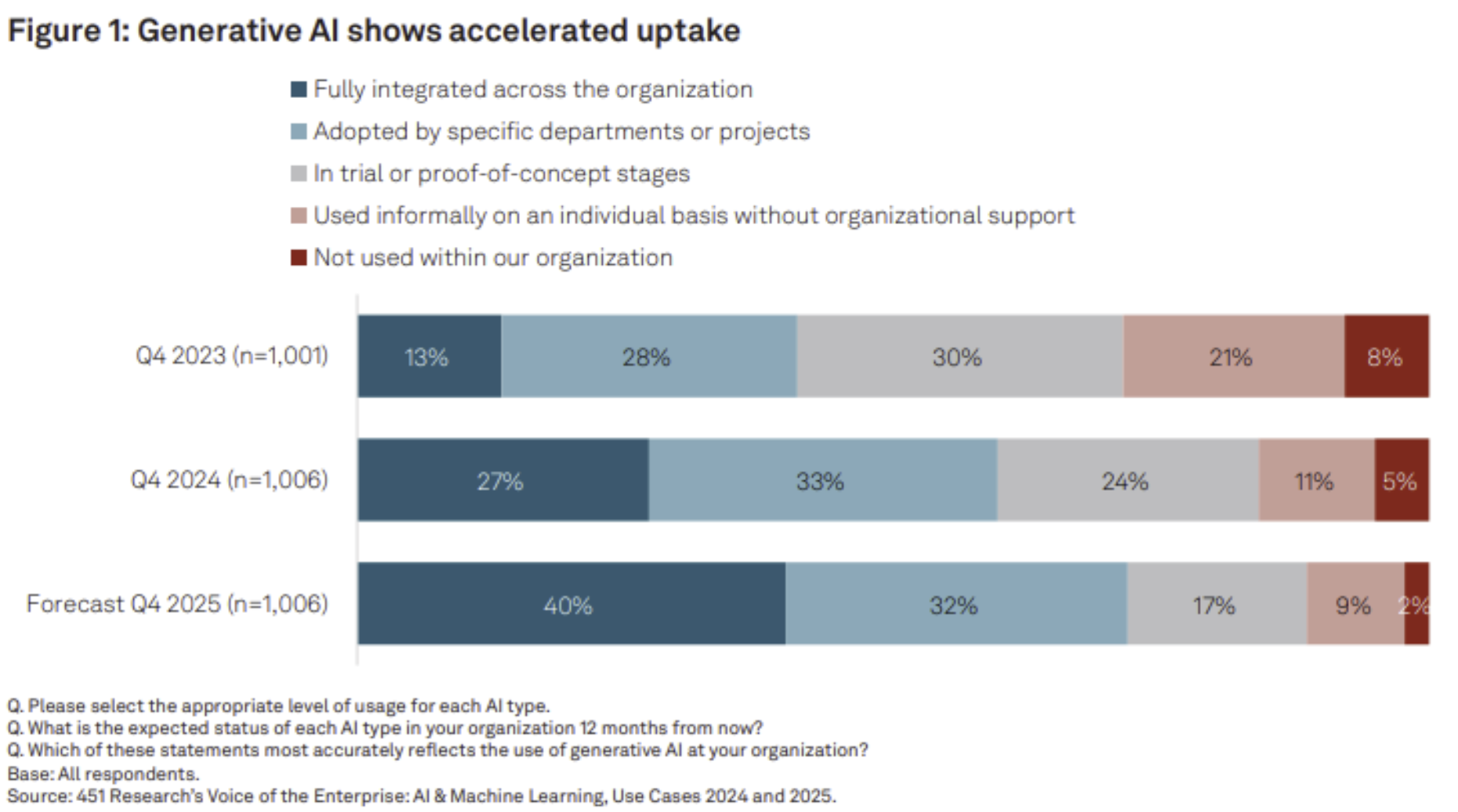
S&P Global: companies shifting to production
While GenAI sometimes seems magical, scaling it up requires effort. What do you do if your AI system has a 50% failure rate?
Rechat, an extensive AI-powered real estate platform, faced this error rate dilemma. Instead of giving up, they embarked on a rigorous continuous improvement process. They tested myriad use cases, documented failures, and implemented solutions. In four months, their system error rate dropped to less than 5%. Given the human and financial effort required, most companies seeking successful AI outcomes must pare back.
One practical outcome of the continuous improvement process is right-sizing system ambitions with production feasibility. In Klarna’s case, the idea that customer support could be done mostly by AI was ambitious. Pulling back to a hybrid approach hopefully captures the best of machine and human engagement.
As companies’ AI journeys continue, focusing on a core set of projects will necessarily result in severe pruning. This is beneficial. Not working diligently to move good ideas from POC to production, though, is not.